
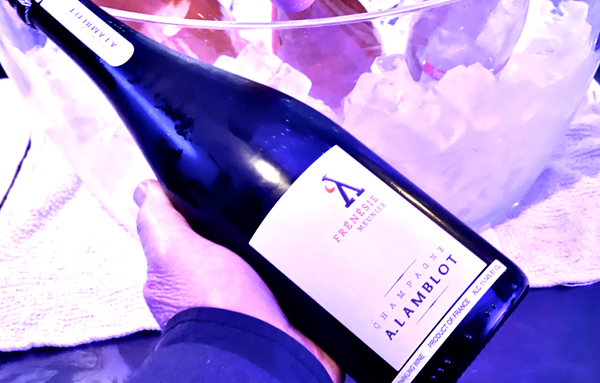
n.v. A. Lamblot, Brut Champagne “Fénésie” Meunier, Montagne de Reims, France.
Alexander Lamblot’s bright gold hued Fénésie Meunier Brut Champagne is wildly delicious and vinous in depth of texture with rich layers of peachy orchard and lemony citrus fruits leading the way along with guava, fig, apple skin, white cherry, yeasty hazelnut, brioche and oyster shell, all framed by a creamy beading mousse. This is a modern grower producer Champagne that is full bodied and impressive in the glass, an outstanding effort that deserves some serious cuisine to match it. Based in the Montagne de Reims, A. Lamblot handcrafts unique naturally style wines, which see a gentle pressing, a fermentation with indigenous yeasts in a mix of 228 to 600-liter barrels, mostly used, and then lees aged abut 11 months. The secondary fermentation in bottle sees a non dosage, Brut Nature style and Lamblot prefers that smoother mousse that brings the fuller and more luxurious mouth feel. The wines rest on the yeast for 24 months in bottle typically and this one is really all about the varietal, Meunier, with full terroir expression. Lamblot is passionate about Meunier and looks to (have) be inspired by the likes of Cedric Bouchard and Jerome Prevost and others in bringing out the best in this grape.
Champagne A. Lamblot, which was all new to me, is a continuation of a family that has been growing grapes in Champagne since the 1600s, but are much more recent in labeling wines under their name, and more recent still young winemaker Alexander Lamblot started doing his own in 2019. I understand that Lamblot has about 3.5 Ha of vines in prime parcels within Vrigny, Chenay, Janvry and Gueux which are mostly vines he inherited from his family, plus some that he rents and farms organically himself. These are made up of approximately 60% Meunier, 25% Pinot Noir and 15% Chardonnay, that were officially certified organic as of the 2021 vintage, and set on a combination of flint and chalk, which contributes to the complexity and distinction here. The La Frénésie (Vrigny) plot is the source of the 100% Meunier seen here in this bottling, one of two of Lamblot’s Meunier only cuvées, grown on Thanetian sands, silt and green clay over limestone soils and vines that were planted in 1984. The new generation of grower producer Champagnes have really embraced Meunier, once called Pinot Meunier, in the last 20 years and wines like this show off its best and most tasty character. Big thank you to my friend Alex Lallos again for bringing my attention to this Champagne and sharing his last bottle!
($89 Est.) 94 Points, grapelive