
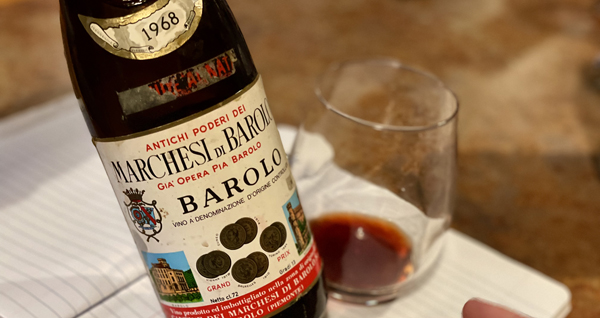
1968 Marchesi di Barolo, Barolo DOCG, Piemonte, Italy.
In the later part of the year I just love tasting old vines and reflecting on their journeys, so it was especially thrilling to taste this almost 60 year year old Marchesi di Barolo from 1968, and while very near to end of life, this was a delicate beauty and still put on a delightful and pure Nebbiolo performance in the glass, many thanks to friends that brought this to our blind Piemonte tasting! I had guessed it was from the 1980s, but was surprised to find it was 20 some years older and the brick infused garnet color was inviting, rather than sad and the nose intrigued with red fruits, woodsy mushroom, dried potpourri and just a hint of sous bois, similar to an old Burgundy, which led to a fine grained silky palate of reduced strawberry, stewed plum, dried cherry and burnt orange fruits, along with earthy truffles, old cedar, mint and black licorice. According to Barolo experts, 1968 wasn’t a memorable year, so I was left with an impressed smile by this wine, which I’m sure would have been truly outstanding in the 1990s, it is one to drink up if you have it. There were moments here that were heavenly pleasure, but it faded and gave way to age, best to pop corks sooner versus later and not go for complicated or heavy cuisine here.
Marchesi di Barolo is a historic winery in the Langhe, famous for its single-varietal and reserve wines produced with Nebbiolo grapes, and obviously most associated with traditionally made Barolo wines, which it is believed to have been born in their cellars between 1814 and 1834 when owners Juliette (Giulia) and Carlo Tancredi moved to Barolo. Interestingly until the late 1700s, most Nebbiolo was made into sweet sparkling wines, mainly because of the grape’s naturally high acidity and fierce tannins, which were difficult to overcome for the winemakers of the time. The Marchesi di Barolo estate, with approximately 120 hectares of vineyards, offers a wide selection of wines. The Barolo is obtained from different parcels vinified separately, with fruit coming from their prime Barolo vineyards, including the legendary Brunate and Cannubi crus. The 1968 we opened had long lived in the winery’s cellars and was offered out many decades later, though we couldn’t know for sure how it was kept in the last couple of decades, so it might have been a little more tired than another bottle, but the fill was nicely as it should be at this stage and the cork was not too bad either, giving us confidence that it was a solid example.
($120+ Est.) 91 Points, grapelive