
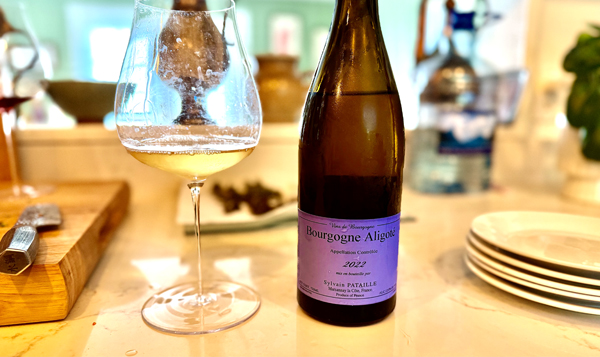
2022 Domaine Sylvain Pataille, Bourgogne Aligoté, White Burgundy, France.
The mineral laced Pataille Aligoté 2022 is wonderfully balanced and a stylish effort with hints of white blossoms, wet stone, lime/citrus and cut straw leading the way on the nose and the palate is vibrant with lemony fruit, apple, white peach and melon, along with yeasty notes, bitter almond, herbal highlights and lingering chalk and sea shore. I’ve long been a fan for these Sylvain Pataille wines, especially the red Marsannay offerings, but I don’t have much experience with the whites, so I was thrilled to get another chance to sample one, thanks to my friend and Sommelier Lee Lightfoot of La Bicyclette in Carmel by the Sea. The village and AOC of Marsannay, is technically part of the Côte de Nuits, and has a solid wine history, became notable in 1783, when it is said that the village got its name, which it owes to its Gallo-Roman roots, mostly like derived from the name of Marcenus. These gentle rolling hillside vineyards enjoy good southern and eastern exposures and dark brown marl based soils that contains a chalky mixture of limestone, calcareous clay, clay and contains pebbles and gravel, which, along with a cooler climate, gives these wines their terroir influence. The Aligoté by Pataille was sourced from biodynamic vines, about 50 years old, 60% from Champ Forey on limestone and gravel soils, and 40% from Auvonnes, which is on clay and marl soils with small stones scattered throughout the vineyard. Aligoté, once dismissed as a non prized varietal, like Gamay, has now become a star, especially the more thought of Doré clone, in the Bouzeron AOC, here in the Marsannay area, where it is championed by some big Burgundy names, like DRC’s Aubert de Villaine, and Sylvain Pataille, as seen here! This impressive 2022 vintage, with its medium body and good ripe fruit, looks like a winner in the short and mid term, and it is a remarkable value in Pataille’s highly sought after lineup.
Sylvain Pataille, who started his own label in 2001 and based in Chenôve, as I’ve mentioned in my prior reviews, makes wines exclusively from the terroirs of Marsannay-la-Côte, and he has become one of the most coveted domaines in Marsannay region, working in a very natural way and using only sustainable and organic methods. Pataille, after studying in Bordeaux, worked as a (very successful) consulting enologist for many estates and has inspired a new generation of talents here. Sylvain does a set of about a dozen wines from Aligote, Passetoutgrain and regional Bourgogne offerings, both red and white to his signature efforts, Marsannay Blanc, Rosé and Rouge, with many prized Lieu-Dits, including this fine example of Aligoté. The Aligoté grape, also known as Blanc de Troyes, Vert Bblanc and Chaudenet Gris, was first documented in the Burgundy region in the 18th century and believed to be native, it is grown in many places now, from Eastern Europe to the United States, but pretty much only taken seriously in the Burgundy region. Typically, Pataille uses all natural yeasts, in his fermentation with temperature control in a mix of stainless-steel tank and fibre-glass vats, before the wines go to cask to mature. This wine though, 100% Aligoté Doré, saw a gentle pressing and was native yeast fermented in used barrels (66%) and in tank (33%), then aged on the lees for 12 months. Interestingly, the AOC regulations allow up to 15 per cent total of Chardonnay, Pinot blanc and Pinot gris as accessory grapes in the red wines, and Pinot Gris may be used in the rosé wines,[ but this not very often practiced now. For white wines, both Chardonnay and Pinot Blanc are allowed in Marsannay labeled bottlings, though not Aligoté, which is under the Bourgogne Aligoté classification, but most whites wines are likely to be 100% Chardonnay. First and foremost, if you’ve not had Pataille’s wines yet you need to do so ASAP, and be sure to get his Marsannay Rouge.
($35-40 Est.) 92 Points, grapelive