
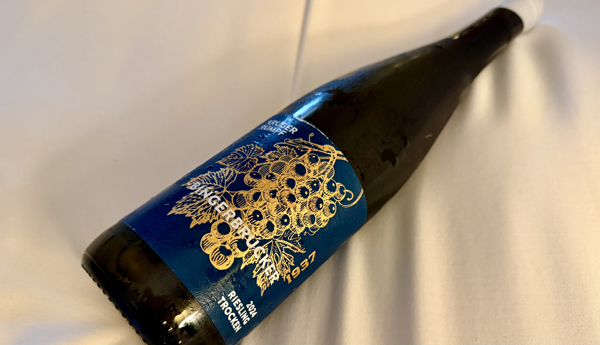
2024 Weingut Kruger-Rumpf, Riesling Trocken, Bingerbrücker “1937” Abtei im Ruppertsberg, Nahe Germany.
One of my favorite dry Riesling wines, and a vineyard site that I visited on my last trip to the Nahe and Rheingau region, the Kruger-Rumpf Bingenbrücker Trocker, is crisply focused with exceptional clarity, terroir driven “slatey” intensity and crystalline in detail. The 2024 vintage has the substance and mineral purity to completely seduce the most jaded of Riesling lovers with a delicious and lively medium bodied palate of peach, lime, green apple and pineapple fruits, along with wet flint, verbena, spicy dried ginger, rosewater, lemon oil, chamomile and a touch of leesy notes. The impossibly steep Kruger-Rumpf Abtei Cru, as mentioned, is the northern most vineyard in the Nahe, which is on the outskirts of Bingen, it was once an almost forgotten Abbey owned plot, across the Rhein from Rudesheimer Berg and is almost a mirror image soil wise to Schlossberg with a beautiful southern exposure. While still just a Premier Cru, this might be the best kept secret in the Nahe. The Rumpf’s have put a lot of blood sweat and tears into working this amazing site, completely rehabilitating this once poorly kept site that is set on phyllite, which is essentially mica slate, all farmed now with organic methods and only hand tending of the vines, do to the severity of the slope. Again this wine shows impressively, it is blessed with elegance, youthful tension and delicacy on full display, and will only get better with age, but also brilliant now with an exotic background of tropical fruit and florals adding charm, depth, and complexity here. I’ve been following Kruger-Rumpf for close to 20 years now, and they are incredibly reliable for quality and value.
The Kruger-Rumpf’s “Abtei” or Bingenbrücker Trocken is sourced from an ultra steep parcel of Rieslings that were planted in 1937, tucked into the most northwestern site in the whole Nahe region just across the river from Bingen and almost a stones throw from the mighty Rhein River and set on metamorphic rock with slate infused soils, and as I have said before, this might be one of the most distinct sites in this celebrated area and this wine is the equal of many much more expensive offerings with an amazing sense of depth and energy. The Kruger-Rumpf estate, which has roots going back to the 1700s was really only founded as a winery in 1984, is located in Münster-Sarmsheim, a small village on the western side of the Nahe River and is highly regarded for their collection of Grand Cru plots and their traditional series of Rieslings, especially their hedonistic Spatlese bottlings and in recent years their collection of dry Rieslings along with their outstanding off dry Scheurebe. This dry Bingenbrûcker 1937 Riesling, coming from these old vines, was fermented with native yeasts or Sponti, (spontaneous) in over 30 years old Stückfässern (German 1200L oak casks) with full lees aging, lasting a full nine months after harvest. As noted before, Georg Rumpf has committed this small estate to organic farming.They keep bees nearby the vineyards to facilitate pollination and aid in overall bio-diversity as well as having sheep helping to control underbrush growth and all of their vineyards are hand harvested to ensure that only optimally ripe grapes are selected, as seen here in this beauty. I’m glad I bought a few bottles, as I am really looking forward to re-visiting this one in 3 to 5 years!
($45 Est.) 95 Points, grapelive