
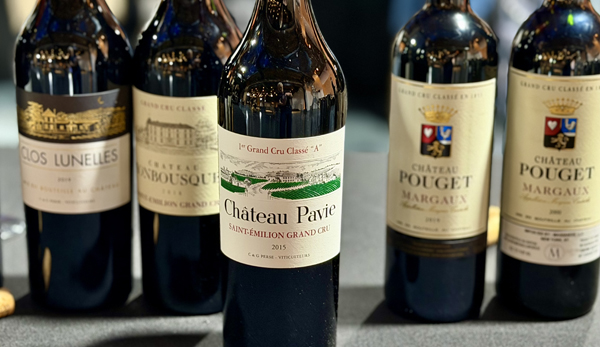
2015 Château Pavie, 1er Grand Cru Classé “A” Saint-Émilion Grand Cru, Red Bordeaux, France.
The dark garnet hued, nicely perfumed and cedary 2015 Château Pavie was showing very well recently, when I sampled it, with loads of blackberry, currant, plum and reduced cherry fruits on the full bodied and velvety palate, along with graphite, toasty sandalwood notes, floral and spiced incense, vanilla, espresso, minty herb and mure liqueur. The Chateau Pavie Grand Vin is traditionally a blend of about 60-65% Merlot, 25% Cabernet Franc and 10-15% Cabernet Sauvignon, with grapes coming from mature vines that average over 40 years old, with the winery being very strict on small yields. There’s more tannin that you initially think and a very subtle loamy/earthy quality in the background too, but yes, as expected the Pavie opulence shines throughout and it’s a heady wine, that definitely needs or requires that right food pairing to show its best side, with a rack of lamb, prime rib and hard cheeses being good ways to see the true complexity and depth here. Sometimes people compare Saint-Émilion to Napa, as the wines can be labeled near 15%, but Pavie tastes like Bordeaux and is, at least this vintage, again with some age, coming together with a bit more poise, if not delicacy. The underlying tannins really carry the finish a long time. Château Pavie, originally dating back to the late 1800s, is more of a modern classic in Saint-Émilion and is located on the plateau to the southeast of St. Emilion village, set on clay and limestone. In 2012 it was classified in the first rank of the Classification of Saint-Émilion wine, and now is a Premier Grand Cru Classé (A), after having previously been only a Premier Grand Cru Classé (B) since 1954. The first Pavie vineyards date back to Roman times and it It takes its name from the orchards of peaches (“pavies”) that used to stand there, long before it became the wine focused Château it is these days. The estate was hard hit by phylloxera, and didn’t really recover until post WWII, and is now owned by Gérard Perse, who recently passed away, and who bought it in 1998. Perse lifted Pavie, along with Château Monbousquet, which he bought earlier to new heights, especially after he hired the late Michel Rolland to over see the winemaking here, his impact is still felt here in the wines. This 2015 grew on me, I came back to again twice and found it more rewarding after I have some food, it would like to see it again in a decade. On a side note, I’m wishing everyone in Bordeaux the best, as wild fires rage through the region and the 2026 red wine vintage is at great risk of smoke taint.
The modern Pavie’s winemaking and vinification includes a 20 plus day maceration in cool temperature-controlled wood vats and after being removed from the skins the wine is then transferred to barrels, with the Grand Vin seeing anywhere between 18 and 32 months in the oak, with 70% to 100% new oak used here, depending on the vintage. Three “Right Bank” Saint-Émilion Bordeaux wines, Château Cheval Blanc, Château Angelus and Château Pavie, you don’t miss or pass up when given the chance and so it was I got to try this 2015 Pavie, when at a trade show in Chicago, and while I’ve moved away from coveting the riper, bigger styles in recent years this was a beauty, with just enough age to allow it to show a bit more finesse and elegance. In modern times, lots of Saint-Émilion has become very similar in style, massive fruit, lots of toasty oak and mostly not overly interesting, and some of that goes back to the Pavie 2005, which was a controversial wine, which Parker loved, but many critics thought went too far to ripe, Port like character, it grabbed attention, both good and bad. I thought at the time, that it wasn’t my style, but didn’t care either way, as there were so many other choices… So I thought, though in reality it turned Saint-Émilion on its head and now 20 years later, an overtly ripe and luxurious profile has emerged here and most classified estates have adopted it. I prefer Bordeaux with structure and age, leaning towards cooler years, and or older wines whenever possible, though I admit 2010 was absolutely outstanding and might be the greatest vintage in my lifetime, rivaling 1982. That 2010 may have been the last young Pavie, I really got excited about, and maybe not quite to that level this 2015 was very delicious and should prove interesting in another 10 to 15 years in bottle. When the Perse family took over Pavie, as noted by the winery, they ripped out most of the old equipment, building new temperature-controlled wooden fermentation vats, a brand new cellar, and a new irrigation system in the vineyard. He brought in the mentioned wine consultant Michel Rolland, who made sure the yields cut severely, pruning and green-harvesting, and the result has seen the wines, as noted, become much more concentrated in style. It will be interesting to see where Château Pavie goes in the future, with both Rolland and Gérard Perse gone, and whether or not they dial back the ripeness and go for a fresher profile, as many properties have started to do. The 2015 Pavie, is not a value option with a high single bottle price on the shelf, but if you can wait, buying 6pks from an ex-cellar offer, usually 3 months, will save you a ton of money.
($350-400 Est.) 94 Points, grapelive