
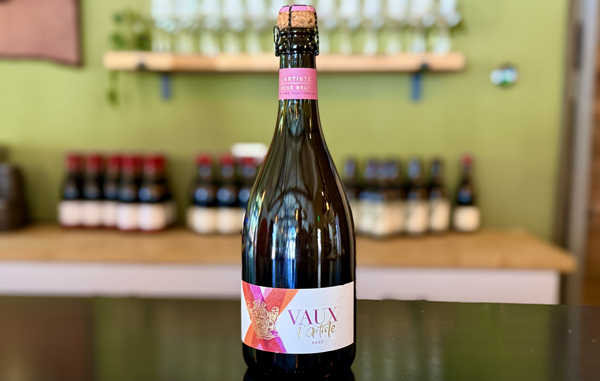
2020 Vaux, l’Artiste Rosé Sekt, Brut Sparkling Wine, Rheingau, Germany.
It was cool to be asked to review this beautiful Vaux l’Artiste Rosé Sekt, especially knowing what a buzz it was creating without me having to type a word, and it definitely lived up to the hype and its well deserved accolades, rivaling Grand Marque and Grower Producer Champagne in the glass. The first I noticed was the delicately golden/coppery hue, rather than a more typical pinkish salmon color and then I was very impressed with the depth, richness, structure and the lively, but opulent mousse. Though cliche, there’s a lot of resemblance to Champagne here, with loads of class and personality on the palate, this Vaux Rosé of Rheingau Pinot Noir shows off baked apple, fig, lemony citrus, toasted hazelnut brioche, bread dough and touch of smoky/flinty spice and subtle mineral tones. Much more serious than maybe one would imagine from a Sekt, Vaux is right up there with Germany’s most notable houses, like Raumland, in the Rheinhessen, which was founded In 1990. The Sekthaus Raumland was brought into being by Volker Raumland, often described as the pioneer in Sekt production and who makes bubble for some of Germany’s most well known wineries. In 2009, I visited the late Helmut Soter in Rüdesheim, who’s Soter at the time was a top Sekthaus and learned about the German way of doing sparkling wine, well before it became such a serious market segment. This vintage Sekt saw 5 years on the yeast, being disgorged in 2025 and while bottle conditioned by hand, the wine, like Champagne Krug, got some oak cask aging too, which gives the vinous and expansive mouth feel here. The Rheingau, in particular, the middle part, where the Rhein is at its widest point, is home to a vast array of varietals and diversity of soils, it is not just Riesling here, with Pinot Blanc, Chardonnay, Pinot Gris, Silvaner and Pinot Noir all finding a place to thrive, along with a few other grapes.
I leaned before I got this bottle, that the Vaux, or Schloss Vaux, based in Eltville, l’Artiste Rosé 2020 was recently been named Germany’s best rosé Sekt in Falstaff Magazine’s latest sparkling wine ranking, earning a top score and first place among the leading producers. This l’Artiste Rosé is, as mentioned, made from all Pinot Noir or Spätburgunder and shaped by Vaux’s distinctive German-French, Champagne inspired, signature, it brings together the distinctive Rheingau fruit, French-inspired finesse, and yeasty luxurious feel, and traditional bottle fermentation, as seen in my own notes above. Vaux’s CEO Christoph Graf, who clearly delighted with the company’s new found fame, notes that the Pinot Noir grapes grow in the Rheingau, on a series of slate, loess, sand, quartzite and clayish soils, which adds to the complexity of this wine. The Rheingau, one of Germany’s most historic wine regions along the Rhine River with many individual and iconic terroirs from Hochheim to Lorch, with the incredible Riesling terraces of the Rüdesheimer Berg Grand Crus and historic greatness of Höllenberg in Assmanshausen and its famed Pinot Noir vines. Vaux’s vinification and aging regime are, again, truly inspired by the French sparkling wine expertise, though the outcome leans into their German culture. The result, Graf adds, is a Sekt that does not understand (its) origin narrowly, but expansively, more as a union of cool fruit, fine wood maturation, long yeast contact and Germany’s noted precise craftsmanship, all of which I found to be true in my experience with this excellent l’Artiste Rosé. I’m even more looking forward to getting back to the Rheingau now, and especially a visit to Eltville, home to one of Germany’s best restaurants Zum Krug and Vaux Sekthaus! Thank you to Wine + Partners, who expertly cover the latest from the Austrian and German wine scene, for sharing this bottle with me, now I hope these Sekthaus Vaux bubblies get imported to the States soon.
($45 Est.) 95 Points, grapelive