
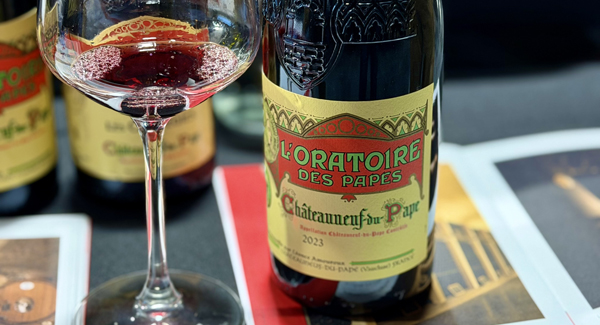
2023 Clos de L’Oratoire des Papes, Châteauneuf-du-Pape Rouge, Rhône Valley, France.
I love the 2023 version of Clos de L’Oratoire Châteauneuf Rouge with its youthful freshness, dark ruby color and its depth of flavors, it couldn’t be anything else and couldn’t e much better, with deep layers of black raspberry, dusty plum, black cherry and Mission fig fruits on the full bodied palate, along with creme de cassis, wild licorice, incense florals, spiced pipe tobacco, cedar and a fine chalky element. Pure Southern Rhône opulence and warm Mediterranean comfort in the glass, but also with a bit of lift and firm silken tannin to provide structure and age worthy balance here, making this a gorgeous terroir driven wine, a bit more graceful and sensuous than the riper feeling 2022s. It was fun to explore the lineup of L’Oratoire this year, via two different tastings, one in San Francisco and one in Chicago with their importer Massanois, and though Clos de L’Oratoire des Papes is most famous for their powerful Châteauneuf Rouge, with good reason, and I also had a chance to dig into the whites too. One of their nicely aged examples of Rouge from the 2016 vintage was near to perfection, but the Les Choregies Cuvée Blanc, mostly Clairette Blanch, as I noted before, quietly stole the show! There are some treasured Châteauneuf reds and whites out there, like Beaucastel, Vieux Telegraphe, which are widely known, as well as small guys like Jerome Gradessi and a few others, but Clos de L’Oratoire should be on your bucket list! As the 2023 Rouge opens, it gains dimension and adds lilac and peppery spice, it really is an impressive and delicious wine, and while Grenache dominates here, the added layers from the Mourvèdre, Syrah and splash of Cinsault are definitely an added attraction here, all lingering on with heavenly fruit concentration.
The Clos de L’Oratoire’s history goes back to 1880, when Léonce Amouroux inherited a parcel of vines on which there was an oratory dedicated to Saint Marc, the patron saint of the winemakers of Châteauneuf-du-Pape, hence the name. One of the most famous of Châteauneuf producers these days, Clos de L’Oratoire des Papes, is set on the site of an 18th century Priory at the edge of this historic appellation in the Southern Rhône Valley. This unique and timeless terroir, set on Urgonian limestone soils is where both L’Oratoire’s vines and underground cellars are located. The US importer for Clos de L’Oratoire de Papes, Massanois says that Edouard Guérin uses his passion and winemaking savoir-faire in the vineyards and cellars alike in order to produce the deepest, most energetic and expressive wines possible, which after tasting this beauty, seems very true. Massanois adds that since 2008, the vines have been cultivated using only organic and sustainable practices and 100% natural fertilizers are employed here, all with the goal of harmonizing with nature in order to achieve optimum balance in the vines to produce wines of purity and depth. Edouard Guérin, who I met in Chicago earlier this year, says climate change is very much affecting Châteauneuf-du-Pape and they are finding many varietals are just not suited for the terroir anymore and he picks out Roussanne as a grape that should not be here any longer as it is now way to hot, he says regularly it gets to 16% natural alcohol in early August, making it almost useless in his wines. For the Rouge, grapes, Grenache, Mourvèdre, Syrah and Cinsault, grown on the classic rolled pebbles, sand, red sandstone and limestone soils, are fermented in cool vats then aged in neutral conical wood casks for 12 months and then another 8 months in concrete, making for a lush, elevated and complex wine, as seen here, and I highly recommend it.
($85 Est.) 96 Points, grapelive