
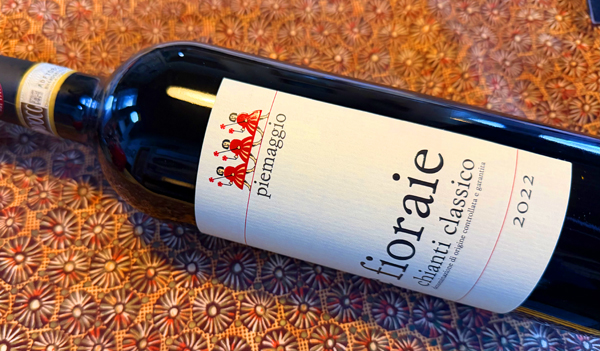
2022 Piemaggio, Chianti Classico DOCG “Le Fioraie” Castelina in Chianti, Tuscany, Italy.
This old fashion and rustically charm Piemaggio Le Fioraie, a deep garnet hued wine, is a 100% native blend of 90% Sangiovese, plus about a 10% mix of Colorino, Canaiolo and Ciliegiolo, which the winery says is the epitome of the archetypal Chianti Classico from the Castellina in Chianti area, and who am I to argue, especially when the wine so utterly delicious and terroir driven. The robust and almost full bodied palate reveals dusty plum, crushed blackberry, black cherry and tangy garden picked strawberry fruits, along with briar notes, subtle leather, tobacco leaf, minty herb, a hint of cedar, anise, candied orange rind and wilted flowers. Fine grained tannin, a structured mouth feel, that begs for food, and a nice lift of classic acidity all come together to provide balance and hold the flavors together nicely, leaving me very happy and impressed by a producer I had not tried before in my memory. Coming from all estate grown grapes and vines set at good elevation, between 350-480 meters above sea level, on alberese and galestro soils, typical of the Chianti Classico region, the Le Fioraie is a very authentic bottling. The winery does the full de-stemming of the grapes and fermentation takes place in temperature controlled stainless steel and sees 25 days of maceration on the skins before racking over to a mix of concrete and used wood casks. The wine is aged for about 18 months in total and is, after the large French oak cask and cement vats finally sees a short period after blending in French oak tonneaux before bottling, after which the wine lays cool in the cellars for an additional settling, typically of 3 to 6 months.
The Piemaggio estate, I leaned, is located at Le Fioraie, a tiny hamlet or village, on the north-western side of the Castellina in Chianti Classico, along the road to Poggibonsi, in the heart of this historic Tuscan region, south of Florence and is highly regarded within the Sangiovese loving wine world. Most locals believe that the name of the estate, Piemaggio, probably originates from the presence of the Pieve (‘Pie’), the small ancient church located on the highest hillside (‘maggiore’) on the property, which certainly is the most viable of possibilities. The winery says the farmhouse itself dates back to the XI-XII century AD and that the remains of the mentioned age-old ‘Pieve’ (church) in the heart of the property, bear witness to the agricultural vocation of the site and the noted religious orders in the middle ages that acted as the custodians of agricultural knowledge in area such as this. The winery explains its label and history through local stories, like the drawing with the three flower sellers on the wine labels, which has represented the identity of the wines since 1954. Le Fioraie, in Italian means ‘the flower sellers’, and of course is the name of the place where the estate is located. Legend has it that the name of Le Fioraie was originally linked to a pilgrim friar who passed by the estate, many centuries ago, one day in a very hot summer and was so exhausted after so much walking in the excessive heat he fainted. Three sisters, local flower sellers, saw the friar crumple on the ground and offered him a glass of wine to revive him and after their kindness the friar thanked the flower sellers and resumed his pilgrimage, but he never forgot them and the place. After a few months he returned, started building a small church and planted a few vines, which may have been the beginnings of Piemaggio. I highly recommend the Le Fioraie Chianti Classico and can’t wait to enjoy it again myself!
($30 Est.) 93 Points, grapelive