
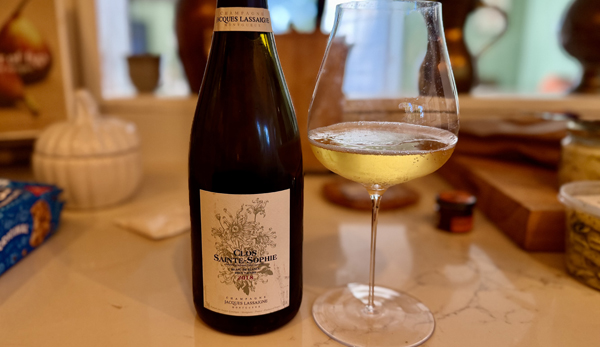
2018 Jacques Lassaigne, Clos Sainte-Sophie, Blanc de Blancs Brut Nature Champagne, Montgueux, France.
The 2018 Clos Sainte-Sophie Blanc de Blancs Brut Nature is a gorgeous, sensually opulent Champagne with loads of character, terroir driven focus and a rich palate of Lemon curd, key lime, quince, fig and apple fruits, along with an exotic clove spice, white flowers, wet flint and yeasty brioche. This Champagne drinks like a fine White Burgundy and its all Chardonnay make up brings out that depth, supple texture and luxurious nature and the mousse is creamy, but harnesses small beading energy and adds to a joyous lift. Lassaigne’s Champagnes are classy stuff and are in the same league of quality characters such as Benoit Dehu, Jerome Prevost, some of Agrapart’s top bottlings, Cedric Bouchard and Boulard, this is unique bubbly that deserves plenty of attention. Certainly I agree that Lassaigne is one of the best and most interesting all the Chardonnay grower fizz wines, and Emmanuel Lassaigne is one of the region’s most exciting producers. I learned that he works with mainly sunny south and southeast-facing sloping hillside vines in Montgueux, which is an isolated outcropping of chalk near Troyes that is, as the winery notes, the geological continuation of the strata of the famous Côte de Blancs. Interestingly, recent studies, as the winery continues, suggest that the hillside that nurtures the Lassaigne vines today might have been the site of the Battle of the Catalaunian Plains, where Aetius and Theodoric defeated Attila the Hun (the first-ever victory for European forces over the Hun army). In 1999, rather than risk losing the estate, Emmanuel quit his successful career in the manufacturing field, to return home at went to work on the vineyards, that his father wasn’t able to keep up with. He converted to all organic farming and began harvesting at full maturity to avoid a sweeter dosage. Lassaigne employs methods to improve soil and vine health with rolled cover crops and under-row cultivation, and in some parcels “tressage” (gently pulling the canopy shoots away from the clusters) that is a more holistic method than hedging, to avoid cutting the shoots, to get better exposure to the sun. As a side note, drink these Champagnes with food, I had this wine, along side a top notch old vine Chassagne-Montrachet, and it was just as rewarding with the meal and never lost its focus and beauty throughout the evening. I might not get this special bottling again any time soon, but Lassaigne’s more available stuff, like his Le Cotet and La Colline Inspirée are certainly grower fizz that I can get and recommend too!
In 2014, I said, Emmanuel Lassaigne looked set to be one of Champagne’s brightest stars, this tiny grower producer in Montgueux (in Aube) which does some fantastic Chardonnay based Champagne from chalky limestone vineyards that have 25 to 45 year old vines, and now, this was proven true. The cuvees he does are all zero dosage and mostly intensely dry Extra Brut in style, but these are seriously endowed bubbly(s) with striking opulence and depth, and while vigorous and precise they have a similarity to Krug and Vilmart with exotic notes and richness. While there is an up rise in pure Pinot Meunier in single vineyard grower Champagnes and it’s all the rage, with good reason, it is important not to forget just how great these Chardonnay wines can be, especially these Jacques Lassaigne offerings from Emmanuel Lassaigne, especially after I enjoyed this one. As I’ve said before, these pure, chalk driven and energetic Champagnes at their best, in my preferred drier non dosage or Extra Brut styles, offering plenty of layers of complexity for the grower producer and or terroir lover, but also these will also turn the heads of the novice Champagne drinkers used to the big houses, or Grand Marques. Typically these all Chardonnay cuvées come from old vine parcels planted in the 60’s and on very thin tuft (chalky) soil in the mentioned area of Montgueux in Champagne’s southern end parts of these blends see some neutral oak barrel aging to allow more complexity and slight oxidation to occur while the rest is raised in tank, with both on the lees, and come with loads of acidity. As hinted at, Lassaigne works uniquely and does a lot of experimentation, often crafting one off cuvées, but he starts with the initial tank or barrel fermentations, all of which are carried out with only indigenous yeast. He only introduces sulfur minimally, mainly at pressing, to prevent oxidation, and then never adds any sulfur again to his distinctive offerings, like this Clos Sainte-Sophie, and his Le Cotet, which is one of my favorites in his lineup. Emmanuel disgorges all the bottles by hand himself, a very uncommon practice in Champagne these days, with even the most artisan of producers using machines to do this work, and that extra care helps make these limited release Champagnes so remarkable and singularly admired by enthusiasts! Thanks again to my very generous Champagne loving friend and professional Alex Lallos of No Limits Fine Wines, who slipped this coveted rarity in my glass and cooked a fabulous home cooked dinner to allow for full enjoyment of this exquisite Lassaigne bubbly!
($229-260 Est.) 96 Points, grapelive