
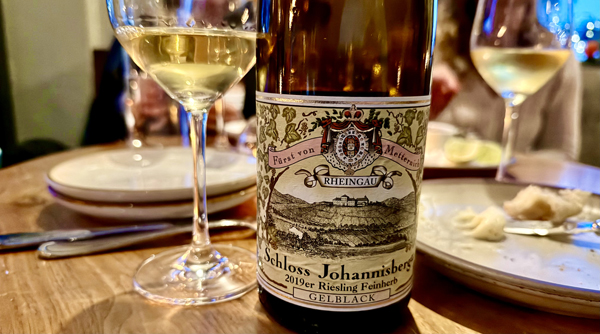
2019 Schloss Johannisberger, Riesling Feinheb, Gelblack, Rheingau Germany.
The truly historic Schloss Johannisberg winery in the Rheingau, the birthplace of modern Riesling, is a must visit if visiting the Rheingau region of Germany, set on rolling hills above the Rhein River it is a very memorable place to go, which I have now done a few times, so it was great to sample a newer release recently. The 2019 Schloss Johannisberg Feinherb, slightly off dry, Riesling is maturing nicely and is drinking very much on the drier side of things, but with a generous palate of mineral driven white peach, green apple, apricot, pineapple and lemony citrus fruits, along with loamy/stony elements, as well as chamomile, wet flint, rosewater, a touch honeycomb and tangy herbs. There’s plenty of zingy acidity and bitter almond notes to keep things fresh and its bright yellow/gold hue is nicely inviting in the glass, making it a balanced and stylishly pure example of old school Rheingau Riesling. Wine has been cultivated at Schloss Johannisberg for 1200 years, and exclusively Riesling since 1720, so can actually taste that in the wines here. The Gelblack on the label usually tells you that the wine is more Trocken or dry in style, as this vintage is. The soils here, differ from the slate of Rüdesheim’s Berg, with quartzite, loam, loess and clay all playing roles to provide complexity and vinous depth, as glimpsed here. The Riesling grapes, for this wine, were hand harvested and gently pressed, with fermentation done in 80% stainless steel and 20% wooden cask, or Stückfass 1200L oak ovals, made from the winery’s own “Schloss Johannisberg” oaks.
Schloss Johannisberg, Germany’s oldest Riesling producer it’s a historic winery which puts a lot of weight on cellar master Gerd Ritter’s shoulders, makes traditional and age worthy Rieslings from vines grown on mixed soils with less slate and more loam in the commune of Geisenheim. The historic Riesling story, as explained to me, begins historically with Count Katzenelnbogen, German wine extraordinaire, logged the first evidence of the Riesling grape near the Rheingau region on March 13, 1435, but it is believed Johannesberg was the first to sell Riesling wines. Riesling’s first real boom time in planting and popularity came in the 1,800’s with all the main church vineyards were directed to dig up other grapes in favor of Riesling with the main regions of the Rheingau, Rheinhessen and the Mosel all adding large vine holdings of Riesling with the top Benedictine abby’s and monasteries being the main producers, these included what are now Kloster Eberbach, Schloss Johannisberg and Schloss Vollards in the Rheingau, though by this time Trier in the Mosel was also a big player. The estate now has fifty hectares, facing exactly south, on a unique quartzite hill in front of the Taunus mountains. With an inclination of 45 degrees, the winery says, that the mountain extends up to 182 meters above sea level and offers the grapes perfect sunshine, for ripening, as can be seen here in in this savvy little Riesling. That said, this is a pretty serious wine that can age quite a bit longer and is wonderfully flexible with food choices, from Asian cuisine to poultry and pork dishes, as well as sea food and cheese.
($29 Est.) 93 Points, grapelive