
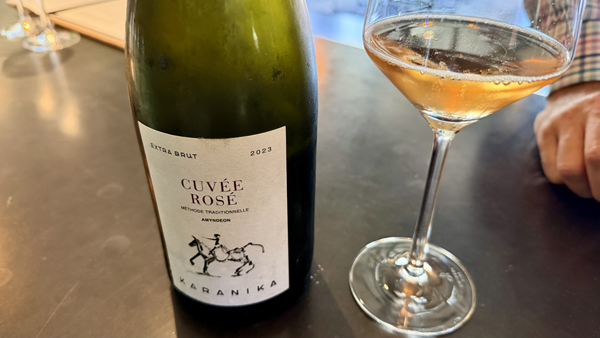
2023 Domaine Karanika, Cuvée Rosé, Extra Brut Sparkling Wine, Amyntaion, Greece.
I hadn’t had Karanika in a long while, having first tried it with their 2012 vintage, and wow, it still blew me away and this Cuvée Rosé vintage Extra Brut Methode Champenoise with its beautiful coppery salmon hue and distinctive mineral toned palate of sour cherry, strawberry, nectarines and lively citrus fruit, along with delicate florals, wet stone, subtle almond brioche leesiness and spice notes. The fine mousse is vigorous, but luxurious, proving the perfect compliment to the complexity of flavors and making this bubbly extremely pleasing and elegant package from a region you’d not expect such a fine sparkling wine to come from. This Extra Brut Rosé is made from one of Greece’s best red grapes, Xinomavro, and comes from the Northern Geek mountainous region of Amyndeon, and up at 700 meters, it is the coldest wine area of the country. Honestly, this is mind-blowing stuff, it rivals some the best single vineyard grower Champagnes, in line with some Pinot Meunier stuff, like Benoit Dehu or Jerome Prevost, and it maybe is one of most inspiring Greek wines I’ve ever tasted. There’s a complex combination of Alluvial, Sandy Loam, Sandy Clay, Sandy Lime soils with Calcium-Rich subsoil that makes this area so good for Champagne style sparkling wines, which plays a pat in Laurens Hartman’s fine efforts here at Karanika. This wine is bone dry, crisp in detail and still plenty generous with an expressive nature in the glass, it is certainly a unique wine and one that is flexible to be more than a curiosity to try, but a serious food wine. I would definitely suggest it with a full and robust meal, although it would be fabulous as aperitif and can be enjoyed on its own. A big thank you to my friend, Lee Lightfoot, who is the Sommelier at La Bicyclette in Carmel by the Sea and who reps Karanika local to me in the Monterey area, for surprising me with this bottle, I was very grateful to re-connect with this winery. I am amazed at the quality and value here and I highly recommend, especially if you have a Greek restaurant, people put these Karanika offerings on their wine lists!
Domaine Karanika is produced by Annette and Laurens Hartman-Van Kampen in Greece’s mainland area in the Northwest, sometimes confusing as it is Macedonia, and this winery is focused on climate climate sparkling wines that are inspired by grower producer Champagne. Laurens Hartman, who’s roots are Dutch, farms all organic and makes his sparkling wine in a classic handmade style, he once made wine in Champagne and so he understands every detail of his craft as well as every nuance of his mountain terroir. This region is more alpine in climate than one would imagine of Greece, even though Greece is home to the second highest range of mountains in Europe, after Switzerland and the Alps. After first trying Karanika more than a decade ago now, it said these Xinomavro sparklers are a marvel in the modern wine world and are a must have wine for Champagne enthusiasts, the exotic charm and class make it hard to put into words just how freaking good they are, and it is pure excitement in the glass, and re-visting this one only confirms it. In 2015, it was a great pleasure to meet and taste with Lauren Hartman in person, who was showing his first imported releases of his bubbly, and his still wines were very solid too. Along with the Xinomavro, Karanika has revived the nearly extinct Limniona variety, which plays a minor role in this Cuvée Rosé (2006) and interestingly, they have introduced Assyrtiko (2006) to the region. This low dosage, Extra Brut Rosé, 98% Xinomavro and 2% Limniona, was gently whole cluster pressed in a membrane press and the juice was vinified with a cool temperature controlled fermentation at 18 degrees Celsius. All the wines here at Karanika see exceptionally low sulphur use, and there are no chemical additives used at all, focusing on the vineyard work to make for healthy grapes. The second fermentation occurs in bottle with the wine aged and hand riddled Sur latte, on the yeast for between 9 to18 months. Then the wine was released three months after its digorgement, allowing for everything to settle into place and show off its best features, as seen here with Karanika’s Cuvée Rosé.
($35 Est) 94 Points, grapelive