
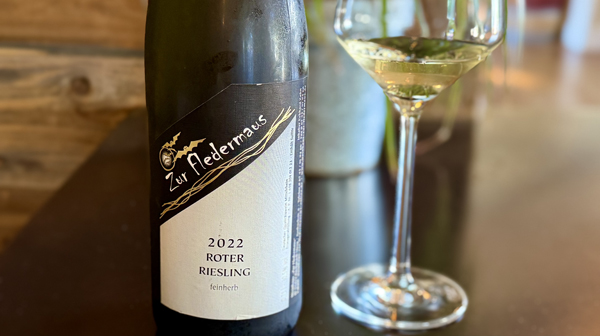
2022 Weinhaus Zur Fledermaus, Roter Riesling, Mittelrhein, Germany.
I’d never had Roter Riesling before, and while it tastes very, very similar to regular Riesling, it was intriguing to try it, a natural and rare pink/red skinned mutation of Riesling, and this Zur Fledermaus 2022, with its straw/gold hue, high energy and fine aromatics, was a delicious dry white wine that I would definitely like to have again and again. The one thing that did stand out here was there was a strong phenolic grip, maybe because this version was fermented bone dry, but it was not unpleasant at all giving more of a green almond character to go along with an intense mineral focus and zesty lime, green apple, tart peach and puckering quince palate. As a lover of Riesling and German wines, I was delighted by this wine and this obscure and curious Roter Riesling grape, which has only a few acres in all of Germany and some in Austria, and the bright flavors and transparent winemaking here made for a joyous experience. Thanks to my friend Jay Lyall, who tasted this wine in Mittelrhein, and who stuffed it in his bags, brought it home and gave it to me. Check another cool oddity off my bucket list of things I wanted to try!
From what I understand here, the Weinhaus Zur Fledermaus (winery) with an estate wine bar and guest house is located in Bacharach, part of the Mittelrhein region, at Borbachstraße, is directly next to the St. Anna Church, whose attic functions as a bat colony, hence the name. The owners here took over the family estate, once known as the Heinz-Friedel Zahn winery in 1994, with Eckhard Zahn and Sonja Theobald-Zahn running the mini hotel and weinhaus these days. Today, their vines grow on just 1.3 hectares and the Bacharach Steeg area is known for its excellent Riesling wines, which is why 95% of their vineyards are planted with Riesling grapes, including a tiny parcel of Roter Riesling, and 5% with Pinot Noir or Spätburgunder grapes. These are simple village wines that are incredible values and common in Germany’s smaller towns in the main wine regions, very similar to what I found on my first visit to the Rheingau in 2009, these are not well known outside their area and almost never seen exported. The Mittelrhein is a lesser known area, with slate and quartz, situated between Bingen and Bonn, with steep gorges and a picturesque landscape. This Roter Riesling was made in stainless steel and is as clean and clear as you’d expect from a German wine, crafted with precision and made to be drunk fresh.
($16 Est.) 90 Points, grapelive